maria black
1975–2019
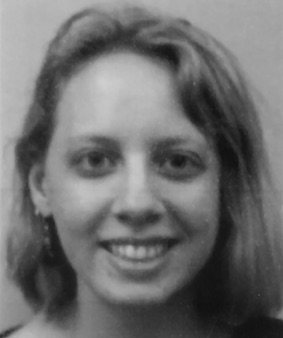
Maria died young, peacefully at the end of spring, after a brief struggle with metastatic breast cancer.
She was an information architect, expert in organizing web sites to help the rest of us find what we’re looking for. Her last working days were spent at the Digital Services team in the Stanford School of Medicine’s Information Resources & Technology group, where she was acknowledged as one who “structures and builds great sites for clients across our vast organization”.
Maria’s work for Stanford included the design of a database, launched shortly after her death, for connecting medical researchers with funding opportunities. She worked selflessly through much of her cancer treatment, well aware that this project would have real benefits for other patients — just like her — in the future.
All her professional life, Maria was fascinated with design and usability. She earned her Master’s in Information Science in 2000 at Indiana University’s School of Library and Information Science. She freelanced for years as an information architect and usability researcher, frequently contracting with web design firm WiredMoon and contributing to many of Stanford University’s numerous web sites during her time in the Bay Area.
Maria was an avid traveler. She visited a majority of the States, Canada, many countries in Europe, and Japan. Maria also read broadly about politics, economics, and history, and read novels voraciously.
Maria also was a theater and movie buff, working tech jobs and stage managing during her undergrad years at Oberlin. Between college and grad school, she worked as a stage manager for Lost Nation Theater in Montpelier, Vermont. She met her future husband Jordan at a job interview for Student Technology Consulting (STC) at Indiana University. Her stage-management experience and calm demeanor led Jordan to recommend her hire, and after he left STC they began dating and stayed together for the rest of Maria’s life: they celebrated their twentieth anniversary in March 2019.
In addition to her husband Jordan, Maria is survived by her parents Ron and Helen Black (of Ohio), and many beloved friends, notably her closest friend Jenne Bergstrom, who flew from Southern California to visit Maria multiple times during her illness.
A memorial was held in mid-September 2019. If you wish to contribute a note about Maria for this site, please email Jordan. In lieu of flowers, donations in Maria’s name may be made to Planned Parenthood or the Walnut Avenue Family & Women’s Center.
Per Maria’s request, please do not post on social media about her death.
memories of Maria
- from Jenne
- from Jordan
- from Brandt Fundak, Maria’s high-school friend, a video tribute
— a note for fellow travelers —
Before she left us, Maria’s wishes included posting the following information online, should any other woman find herself looking at this Web site following a similar diagnosis: Triple negative breast cancer — specifically, invasive ductal carcinoma, with lymph node involvement and metastases in the lung, liver, and spine.
From diagnosis to death, the disease took sixteen months. Maria chose to participate in two clinical trials — albeit ones with decent likelihood of lasting favorable results — both to support human knowledge, and to choose the possibility of a prolonged “normal” life (or less-prolonged death, as it turned out) over the familiar courses of long-term treatment (and their familiar side effects) via the standard battery of chemotherapies.
Trial #1 was of the immunotherapy treatment atezolizumab (or a placebo; it was a double-blind trial) given in concert with Taxol.
Trial #2 was a gene therapy (IL-12) injected into the main breast tumor and followed by transcutaneous electrical stimulation of the tumor cells, with several doses of pembrolizumab (definitely not placebo) also given over the course of her six-week treatment cycle.
Initially she responded favorably to the gene-therapy and immunotherapy treatments, but the disease grew too fast, overwhelming her liver. When it became clear that her odds of surviving were very low, she requested palliative care and a dignified and comfortable death at home.
An atheist, Maria found solace in her firm belief that the trials and joys of life are neither dealt nor guided by any hand, malevolent or benign. She believed that her disease, unpleasant though it was, was not wished upon her by anyone, and that in death she would find both eternal peace and beautiful freedom from the ravages of sorrow, struggle, and time.
This belief also offers some comfort: in situations like cancer treatment, all we can do is make our best guess and play the odds. Despite the outcome, Maria felt she’d made the best possible treatment decisions given what she knew at the time, with the support of the best medical knowledge and skills available. She would wish you the same — and better luck in your own treatment.